

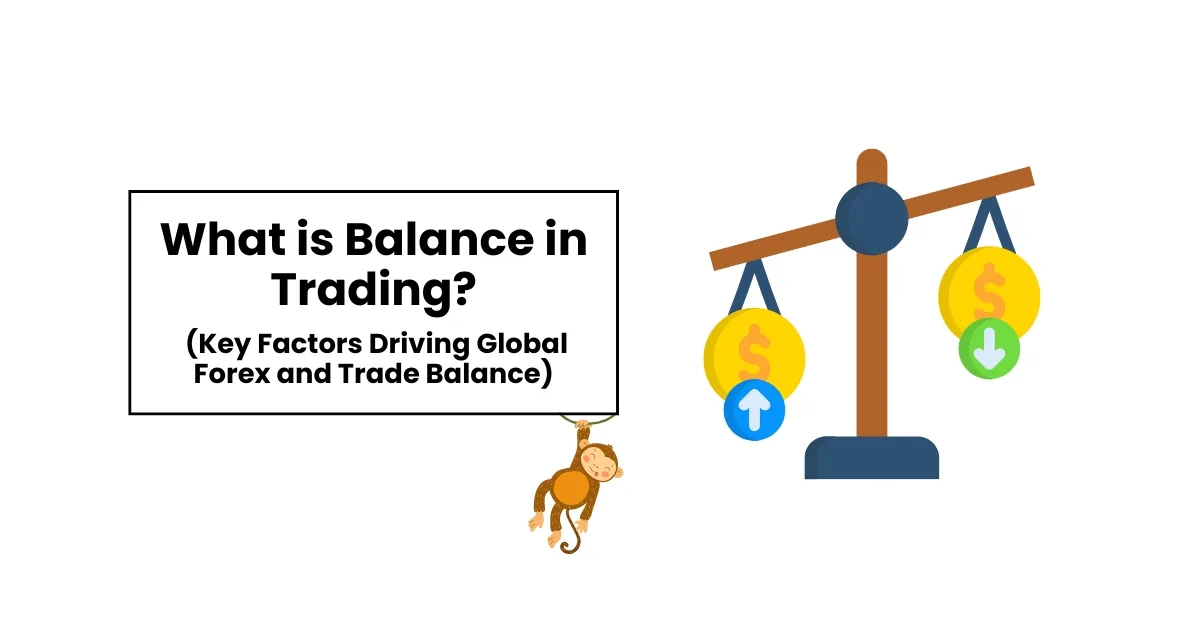
What is Balance in Trading? Key Factors Driving Global Forex and Trade Balance
Other Post


Global trade and forex markets are interconnected. Yes, it is witnessed every day when countries are buying and selling goods, services, and currencies. It is the kind of trade that is executed 24/7, creating what experts call balance in trading. This basically allows us to understand whether a country is making money from global trade or is spending more on imports.
Understanding balance in trading is essential as it helps us figure out why currencies go up or down. When a country sells a lot of goods to other countries, the value of its currency usually gets stronger. However, when it buys a lot from other countries, its currency might get weaker. This balance in trading has an effect on global markets, investors, and people who trade forex.
In this blog, you will understand what balance of trade means, its effect on forex, how interest rates and demand and supply work together, and more. So, let’s dive in.
What is Balance in Trading?
The stability in a country’s exports, imports, and currency value in global markets is called balance in trading. Basically, it indicates how trade activities affect a currency’s strength or weakness.
To put it simply, the more a country exports, the more it earns foreign currency, resulting in increased demand for its currency. Whereas the more imports a country makes, the more it spends, resulting in an increase in supply, which might weaken the currency.
This balance helps maintain economic stability and smooth forex market movement.
Trade Balance Forex Explained
Trade balance means how it affects a currency’s trading in the global markets. It is closely monitored by forex traders as it directly impacts a currency’s demand and supply.
For example:
- Strong trade balance → currency demand rises → forex value increases.
- Weak trade balance → currency demand falls → forex value decreases.
Thus, balance in trading plays an important role in currency movements as forex markets react quickly to trade reports and economic data.
Balance of Trade Definition
The difference between a country’s exports and imports is called the balance of trade.
Balance of Trade = Exports – Imports
A country experiences a trade surplus when exports are higher. Whereas, when imports are higher, a country has a trade deficit.
This is a crucial economic indicator used in the global markets.
Why Balance of Trade Matters
Here are some reasons the balance of trade matters. Let’s understand them in brief:
- Currency strength: When a country exports, more people want to buy its currency, making it stronger. If it imports more, its currency becomes weaker.
- Economic growth: A good trade balance helps the economy grow. It does this by making things sell more in other countries, creating jobs, and increasing the country’s income over time.
- Inflation levels: The trade balance affects prices. If a country imports things, prices go up. If it exports a lot, it helps keep prices stable and under control.
- Foreign investment: A healthy trade balance makes foreign investors more confident. They see that the country’s economy is stable and has growth opportunities, so they invest more.
- Market stability: A stable trade balance helps keep currency values steady. This makes it easier for traders to predict what will happen and for countries to trade with each other smoothly.
| Situation | Meaning | Currency Impact |
| Export more than import | Trade surplus | Currency becomes stronger |
| Import more than export | Trade deficit | Currency becomes weaker |
| Equal exports and imports | Balanced trade | Currency remains stable |
A strong balance of trade supports economic growth and builds investor confidence.
United States Balance of Trade Example
The US balance of trade is often in deficit. This means the United States buys more goods than it sells. For example, it imports electronics, oil, and manufactured products from other countries. At the time, it exports technology, services, and agricultural goods.
With a trade deficit, the US dollar stays strong.
This might seem confusing, but there are good reasons behind it.
Why the United States Balance of Trade Still Supports the Dollar
The US balance of trade affects markets because the US dollar is the world’s reserve currency.
Here are reasons the dollar stays strong:
- Many countries use the US dollar for trade and reserves. This increases demand. Keeps the dollar strong in global markets.
- The United States has stable financial markets. These attract investors. Help keep confidence high. This supports the dollar’s strength.
- Foreign investors put a lot of money into US companies and government bonds. This increases demand for dollars. Strengthens the currency over time.
- During uncertainty or crisis, investors move money into US dollar assets. They trust the stability of the US economy.
- The US economy is large and stable. It has institutions and policies. These help keep currency strength and investor confidence high globally.
This shows that balance in trading is not about exports and imports. It’s also about confidence and investment.
Key Factors that Drive Balance in Trading
There are many economic conditions that give shape to the balance in trading globally. Let’s discuss these factors in brief:
1. Currency Appreciation & Depreciation
Currency appreciation and depreciation play a major role in global trade as they denote the strength and weakness of a currency. Let’s understand both of them in brief:
Currency appreciation is witnessed when a currency becomes stronger. It is also noticed that when a currency is appreciated, exports are expensive, imports are cheaper, and the trade surplus might decrease.
Currency depreciation is seen when a currency becomes weaker. Such a country experiences cheaper exports, expensive imports, and an increase in trade surplus.
In simple terms:
- Strong currency hurts exports.
- Weak currency supports exports.
This directly affects balance in trading.
2. Demand-Supply Dynamics in the Forex
Demand and supply are the basic forces that move currencies. Let’s understand how it works.
When there is a high demand for a currency, its value rises. Whereas, when there is low demand, value falls. This means when supply is high, the value of the currency drops, and if the supply is low, the value increases.
Here is an example:
- More exports increase currency demand.
- More imports increase currency supply.
This creates movement in forex markets and affects the trading balance.
3. Safe-Haven Inflows
Safe-haven inflows are seen to occur during global uncertainty. This basically means that when markets are in crisis, investors shift their money to stable currencies.
Some common safe-haven currencies include:
- US Dollar
- Japanese Yen
- Swiss Franc
During such an economic or geopolitical uncertainty, three major activities are noticed:
- Investors are buying safe currencies
- Rising Demand
- Currency strengthening
All of this can collectively lead to a temporary change in the trade balance.
4. Interest Rate Differentials
Interest rates are one of the biggest drivers of forex markets. Here are some ways interest rates affect balance in trading:
- High interest rates attract investors.
- Investors buy the currency.
- Currency becomes stronger.
- Imports become cheaper.
- Exports become expensive.
Now, you might think what interest rate differentials?
This basically is the difference in interest rates between two countries.
For Example:
- Country A interest rate = 5%
- Country B interest rate = 2%
Investors move money to Country A.
This strengthens the currency and impacts the trade balance.
5. Foreign Exchange Reserves
These reserves are the assets held by central banks in foreign currencies.
This helps:
- Stabilize currency
- Support trade
- Control inflation
- Maintain market confidence
Moreover, these reserves matter because:
- Strong reserves protect currency.
- Central banks can control volatility.
- Trade balance remains stable.
Countries with high reserves usually have better control over their trading balance.
6. Fiscal Dominance
When a country has heavy government spending and large budget deficits, it is known as fiscal dominance. Such a situation is usually seen when governments spend too much, resulting in:
- Debt increases
- Inflation rises
- Currency weakens
- Trade balance suffers
The impact of fiscal dominance is seen in the form of
- Currency weakening
- High import costs are charged
- Increasing economic pressure
- Reduced investor confidence
Fiscal dominance can disturb the balance between trade and currency stability.
How Balance in Trading Affects Forex Traders
Balance in trading is essential for forex traders as it helps them to understand the currency movement. It usually causes the market to be uncertain and brings in major shifts.
When the market becomes volatile, the trade balance reports usually drive market movements.
During such a situation, traders watch:
- Export data
- Import data
- Trade deficit
- Interest rates
- Economic indicators
This helps traders foresee currency trends.
However, understanding balance in trading also gives traders an upper hand in managing potential risks efficiently. This risk management allows a trader to:
- Avoid sudden market shocks
- Plan better entries
- Make informed decisions
Traders who follow economic indicators usually perform better in global forex markets.
Real World Example of Balance in Trading
Let’s understand the concept of balance in trading with a simple example:
| Country Type | Trade Balance | Currency Movement |
| Export-driven country | Trade surplus | Strong currency |
| Import-heavy country | Trade deficit | Weak currency |
The above table shows how country A has high exports and owns higher foreign income, resulting in having a strong currency. Whereas country B has high imports, which means it spends more and results in weakening the currency.
Thus, forex markets react according to this balance, and this is exactly how balance in trading works in the real world.
Why Balance in Trading Matters in 2026 and Beyond
The importance of maintaining balance in trading activities extends beyond the current year 2026 to future periods. This is because global markets show increasing interconnectedness, which develops into a stronger trend. The current state of trade and forex markets enables them to respond to market changes with unprecedented speed.
Here are the key reasons why balance in trading is important:
- Global trade is increasing
- Currency markets are interconnected
- Economic policies are changing
- Interest rates are rising worldwide
- Geopolitical risks are growing
- The digital economy is expanding
Countries need a strong trade balance to maintain stable currencies and economic growth.
For investors and traders, understanding balance in trading is no longer optional. It is essential for making smart financial decisions.
Conclusion
Balance in trading plays a crucial role in connecting global trade, currency value, and forex market stability. The balance of trade, interest rates, demand-supply dynamics, foreign exchange reserves, and fiscal policies all influence the movement of currencies in international markets. Understanding these factors helps readers establish a solid foundation in global economics and foreign exchange behavior. Continuous learning about trade balance and currency movements is essential for making informed financial decisions in today’s fast-changing world.
To deepen your understanding, explore Market Investopedia, which offers simple and reliable financial learning resources for beginners and market learners across global markets.
FAQ’s
It refers to when a country’s total value of exports surpasses its total value of imports over a period. This indicated a positive trade balance.
A balance of trade deficit happens when a country imports a higher value of goods and services from foreign countries than it exports. It represents an unfavorable balance.
The balance of trade is calculated by removing the total value of a nation's imports of goods and services from the total value of its exports.
It is witnessed when total exports of a country exceed imports over a period of time.
AUD/USD, USD/CAD, USD/CNY, USD/JPY, and GBP/USD are the most sensitive currency pairs to the balance of trade.
No, trade deficit doesn’t always mean a currency will weaken. It creates downward pressure on a currency's value, but it is not an immediate cause for depreciation.
Category :
Share :