


If you are a trader, you can understand that practising trading is a tricky business. This is because there are multiple terminologies involved that one should be aware of. These financial markets and charts constantly keep changing positions, moving in ways that confuse beginner traders.
One minute, the price breaks resistance levels and looks ready to rise higher, and the next minute, it suddenly drops, creating losses. This behavior of the market is called liquidity grab.
Understanding liquidity grabs helps traders to be aware of fake breakouts and take wiser trading decisions. This blog will help you understand liquidity grabs and its working in simple words. So, let’s dive in.
What Does Liquidity Mean in Trading?
Liquidity refers to the ease with which an asset can be bought or sold without creating significant price changes.
For example:
- If many buyers and sellers are active → high liquidity
- If very few buyers and sellers are active → low liquidity
Banks, hedge funds, and market makers, also known as big institutions, trade huge amounts of money. They require sufficient buyers and sellers to process their trades. This is the reason they look for high liquidity zones. It is the zone where other traders have placed their orders.
These zones usually include:
- Previous highs
- Previous lows
- Equal highs
- Equal lows
- Trendline breakout areas
- Major support and resistance zones
- Psychological levels like 100, 500, or 1000
These areas attract many stop-loss orders and pending trades.
What is Liquidity Grab?
A liquidity grab occurs when a price exceeds a critical threshold, which activates traders’ stop loss and breakout execution orders before the market reverses its movement.
The price movement creates a false impression at first, which leads traders to believe a market breakout will occur.
Gold currently trades under its resistance level, which exists at $3,300.
The price moves to break through the $3,300 resistance level.
A large number of traders enter the market to purchase the breakout.
- The price drops through the resistance level, which it had just broken.
- The breakout buyers have become stuck in their position.
- The price movement above the resistance level created a liquidity grab operation.
Large market participants use this method because they require market liquidity to establish their substantial positions.
How Does a Liquidity Grab Work?
The system operates through several stages.
Step 1: Retail traders identify obvious levels
Traders from various backgrounds all identify the same support and resistance areas.
Step 2: Stop losses build up
Traders create stop loss orders, which they place above market peaks and below market troughs.
Step 3: Institutions push prices toward these levels
The market operators drive the asset value toward these specified price points.
Step 4: Orders get triggered
The market creates liquidity through both stop loss orders and breakout entry orders.
Step 5: Price reverses
The market movement occurs after sufficient order collection reaches its target point.
A store uses a fake sale sign that attracts customers to enter the store. The authentic sale location existed in a different place.
Liquidity Grab vs Liquidity Sweep
There is a significant difference between liquidity grab and liquidity sweep. Yet, many traders get confused between the two terms. So, let’s understand them in brief:
A liquidity grab is a sharp price movement that targets a major support or resistance level where stop-loss orders are placed. Price briefly moves beyond that level, triggers those stops, and then reverses almost immediately in the opposite direction.
A liquidity sweep, on the other hand, is a broader move where price pushes through multiple liquidity zones or levels over a longer period. Unlike a grab, the move may continue for some time before showing signs of reversal, making it harder for traders to identify early.
For example,
- A quick move above yesterday’s high and immediate reversal = liquidity grab.
- A move that clears several highs before reversing = liquidity sweep.
How to Identify a Liquidity Grab Candle
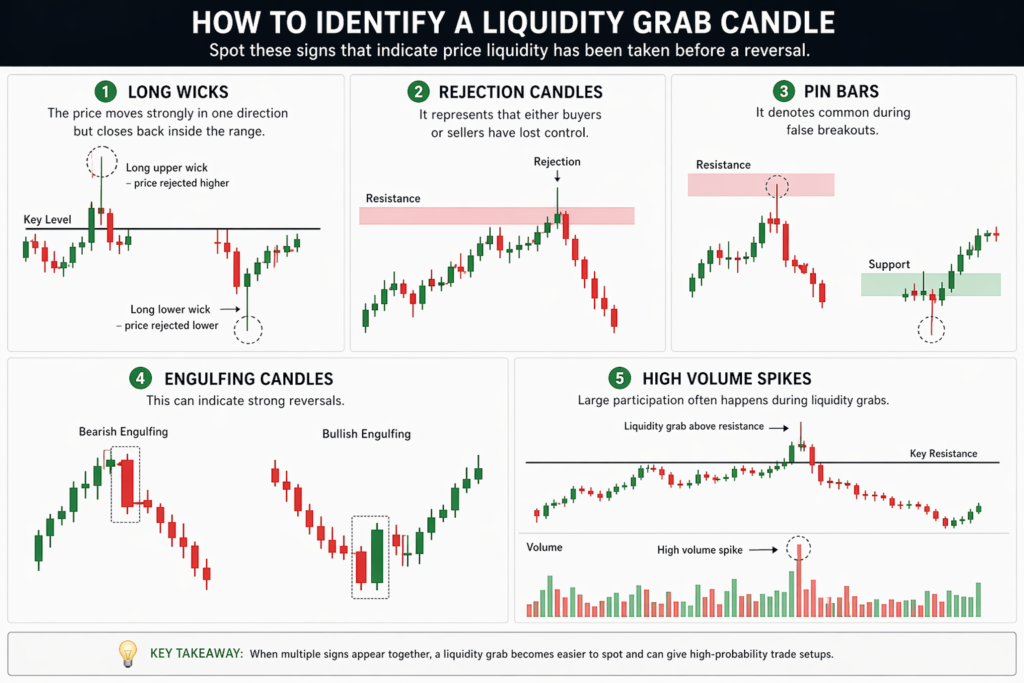
Apart from the bookish knowledge, you need to understand the process of identifying a liquidity grab candle. It usually gives strong clues that you must look for. Let’s discuss those indicators in brief:
Long wicks
They can be noticed as the price moves strongly in one direction. However, it closes back inside the range.
Rejection candles
It represents that either buyers or sellers have lost control.
Pin bars
It denotes common during false breakouts.
Engulfing candles
This can indicate strong reversals.
High volume spikes
Large participation often happens during liquidity grabs.
For example:
If price breaks above resistance and forms a candle with a long upper wick, it may signal trapped buyers.
Liquidity Grab Chart Patterns
A liquidity grab chart usually forms around common technical setups. Let’s discuss them in brief:
- Double tops
It is witnessed when the price breaks above the previous high and reverses lower. - Double bottoms
It is seen when the price goes below support and reverses upward. - Trendline break traps
Here, the price breaks trendlines but fails quickly. - Range breakout traps
Price exits a range and immediately returns inside. - Support and resistance fakeouts
It is very common in forex, crypto, and stock markets.
These setups happen because many traders place orders at obvious chart levels.
Which are the Best Liquidity Grab Indicators?
One cannot spot a perfect liquidity grab indicator. However, here are some tools that can help. Let’s discuss them in brief:
- Volume indicator: It shows sudden spikes in activity.
- RSI divergence: It can signal weakening momentum.
- VWAP: It helps identify fair value zones.
- Order block indicators: It is used by smart money traders.
- Session indicators: It is useful for finding moves during the London or New York sessions.
One should keep in mind that these indicators only support your analysis; they do not replace chart reading.
Best Liquidity Grab Trading Strategy
If you want to create a clear and easy liquidity grab trading, here is one that you can use, to begin with:
Step 1: Mark liquidity zones
You need to identify equal highs, equal lows, support, and resistance.
Step 2: Wait for price manipulation
Next, you need to allow the price to break above or below the zone.
Step 3: Look for reversal confirmation
Watch for rejection candles or market structure shifts.
Step 4: Enter the trade
Enter after confirmation.
Step 5: Place a stop loss
Keep stops beyond the liquidity zone.
Step 6: Set take profit
Aim for the next support or resistance level.
This strategy works best when combined with patience.
How to Trade Liquidity Grabs Safely
To trade liquidity grabs successfully, you need to manage risk. Here are some ways that you can do it effectively:
- Never trade much, this means you must only go for the trades that not only look good but have the potential to work positively for you.
- Use stop losses to limit losses and keep your account safe.
- Don’t make decisions based on emotions. This usually leads to chasing prices that move quickly, making you end up at a loss.
- Trade when the market is active. Like the London and New York sessions have higher liquidity, offering big moves.
- Wait for a sign that it’s going to happen.
- And last but not least, don’t enter a trade after a big breakout.
Common Mistakes Traders Make
New traders often lose their money as they make mistakes. So, to help you be aware and not fall into the same holes, here are some common mistakes that you must know.
Enter too early
Many traders take trades as soon as the price reaches the key level without giving it a second thought. This often leads them to get trapped in fake moves.
Ignore trend direction
Some traders take huge risks by trading against the market, and liquidity grabs are known to work better when it is aligned with a larger trend.
Risk too much money
New traders take a risk on a huge amount of money on a single trade that leads to major losses after a wrong move.
Use too many indicators
Making use of too many indicators can build up confusion as signals might conflict. This can make the traders hesitate to enter a trade based on unclear setups.
Revenge trade after losses
After losing a trade, some traders immediately try to recover money by taking random setups, which often leads to bigger losses.
Confuse real breakouts with fakeouts
Usually, traders make mistakes by executing temporary liquidity grabs for a real breakout and entering late to watch the price reverse against them.
Learning patience can solve many of these problems.
Waiting for confirmation, following a clear strategy, and avoiding emotional decisions can help traders make smarter and safer trading choices.
Pros and Cons of Liquidity Grab Trading
Here are the pros and cons of liquidity trading to help you understand it more clearly:
| Pros | Cons |
| Offers strong risk-to-reward opportunities when entries are timed correctly. | False signals can happen, especially in highly volatile markets. |
| Helps traders identify fake breakouts and avoid common retail traps. | Requires patience and discipline to wait for confirmation. |
| Works across multiple markets like forex, crypto, stocks, and commodities. | Beginners may struggle to identify valid setups accurately. |
| Provides clear entry, stop-loss, and take-profit levels. | News events can create unpredictable price movements. |
| Improves understanding of smart money and institutional behavior. | Can lead to losses if traders ignore proper risk management. |
| Can be combined with price action and market structure strategies. | Overtrading liquidity grabs may reduce overall profitability. |
Conclusion
Liquidity grabs occur at regular intervals across all forex markets, cryptocurrency markets, stock markets, and commodity markets. The market movement traps traders who enter breakouts before completing their verification process.
Traders can improve their trading decisions by mastering liquidity grab operations, learning essential chart patterns, and implementing effective risk control methods.
Successful trading requires traders to maintain their capital through consistent application of their trading strategy instead of attempting to predict every market movement.
Market Investopedia serves as a resource for beginners who wish to study trading concepts and market strategies and access beginner-friendly guides to develop their market knowledge before engaging in actual trading.