




Stay ahead of the market moves.
Forex Weekly Outlook: What’s Moving the Market This Week
4 May – 8 May 2026
Over $7.5 trillion trades daily in the forex market, and this week is packed with the kind of events that can shift trends in minutes, not days. From US Nonfarm Payrolls and labor data to the RBA interest rate decision and rising geopolitical tensions, volatility is expected to stay elevated across major currency pairs.
But here’s the real edge most traders miss: markets are not just reacting to scheduled news anymore. Oil price shocks, central bank uncertainty, and surprise headlines are quietly driving the biggest moves.In this newsletter, you’ll find:
- The most important forex news events (filtered, no noise)
- Hidden market drivers not shown on economic calendars
- Key currency pairs to watch
- Practical trading tips to navigate volatility
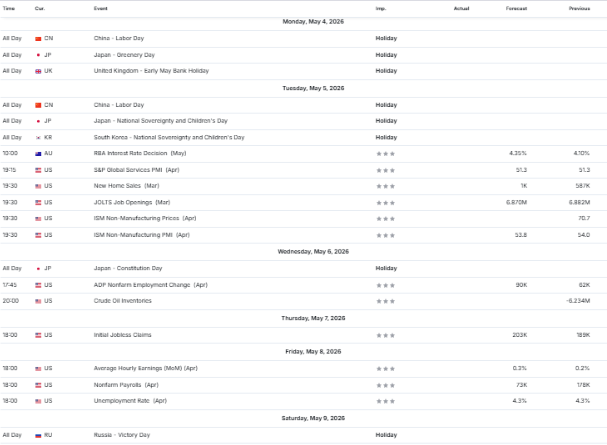
RBA Interest Rate Decision Outlook: AUD Volatility Expected as Traders Watch Policy Guidance
The Reserve Bank of Australia's interest rate decision is a major forex market event influencing AUD pairs. Traders closely monitor forward guidance, inflation outlook, and policy tone to assess whether tightening or easing cycles will continue.
Impact:
Hawkish signals could push AUD higher across forex pairs, while dovish commentary may trigger selling pressure as markets price in weaker growth and future rate cuts.
Hawkish signals could push AUD higher across forex pairs, while dovish commentary may trigger selling pressure as markets price in weaker growth and future rate cuts.
US JOLTS Job Openings Data Signals Cooling Labour Market, Raising USD Weakness Concerns
The US JOLTS job openings report reflects labour demand and economic strength. A continued decline suggests businesses are slowing hiring, indicating weakening economic momentum and reduced wage-driven inflation pressure in the US economy.
Impact:
Softer labour demand may weaken USD as traders increase bets on Federal Reserve rate cuts and a slower economic growth outlook.
Softer labour demand may weaken USD as traders increase bets on Federal Reserve rate cuts and a slower economic growth outlook.
US ADP Employment Change Beats Forecast, Supporting Short-Term USD Strength in Forex Market
ADP employment data provides an early signal of US labour market conditions ahead of Nonfarm Payrolls. Strong readings indicate economic resilience, suggesting businesses are still hiring despite tightening financial conditions.
Impact:
Strong data could support USD in the short term, especially if markets adjust expectations toward delayed Federal Reserve rate cuts.
Strong data could support USD in the short term, especially if markets adjust expectations toward delayed Federal Reserve rate cuts.
Crude Oil Inventory Drawdown Drives Oil Price Rally, Boosting CAD Strength in Forex Market
A sharp drop in US crude oil inventories indicates tightening supply or rising demand. This typically supports higher oil prices, benefiting commodity-linked currencies like the Canadian dollar in global forex markets.
Impact:
Rising oil prices may strengthen CAD, particularly against weaker currencies, while also influencing inflation expectations and central bank policy outlook globally.
Rising oil prices may strengthen CAD, particularly against weaker currencies, while also influencing inflation expectations and central bank policy outlook globally.
US Initial Jobless Claims Rise, Indicating Labour Market Softening and USD Pressure
Initial jobless claims measure new unemployment filings and provide real-time insight into labor market conditions. Rising claims suggest increasing layoffs and a potential economic slowdown in the United States.
Impact:
Increasing claims could pressure USD lower as traders anticipate a weaker economic performance and a more dovish Federal Reserve stance.
Increasing claims could pressure USD lower as traders anticipate a weaker economic performance and a more dovish Federal Reserve stance.
US Nonfarm Payrolls Miss Expectations, Triggering High Volatility in USD Forex Pairs
Nonfarm Payrolls is the most influential US economic indicator for forex traders. A weaker-than-expected reading signals slowing job growth, impacting interest rate expectations and overall market sentiment.
Impact:
Weak NFP could trigger sharp USD sell-offs, increasing volatility across major forex pairs as traders reassess growth outlook and policy direction.
Weak NFP could trigger sharp USD sell-offs, increasing volatility across major forex pairs as traders reassess growth outlook and policy direction.
US Unemployment Rate Holds Steady, Highlighting Mixed Signals in US Labour Market Outlook
The US unemployment rate reflects overall labour market health. Stable figures may appear positive, but when combined with weak job growth, they can signal underlying economic softness.
Impact:
Mixed data may keep USD volatile, with no clear directional bias until stronger confirmation from future economic indicators.
Mixed data may keep USD volatile, with no clear directional bias until stronger confirmation from future economic indicators.
Middle East Tensions and Iran Conflict Drive Oil Price Volatility, Boosting Safe-Haven Demand
Ongoing geopolitical tensions in the Middle East, especially involving Iran, are creating uncertainty in global markets. These risks can disrupt oil supply and push investors toward safer assets like the US dollar and Japanese yen.
Impact:
Escalation could strengthen USD and JPY while weakening risk-sensitive currencies, as traders shift toward safe-haven assets during global uncertainty.
Escalation could strengthen USD and JPY while weakening risk-sensitive currencies, as traders shift toward safe-haven assets during global uncertainty.
Strait of Hormuz Risk Sparks Forex Volatility Amid Oil Supply Shock Fears
The Strait of Hormuz is a key global oil shipping route. Any disruption here can limit supply, causing oil prices to surge and creating widespread volatility across currencies and financial markets.
Impact:
Supply disruptions may spike oil prices, strengthening CAD and safe-haven currencies, while increasing overall forex volatility and risk-off market behaviour.
Supply disruptions may spike oil prices, strengthening CAD and safe-haven currencies, while increasing overall forex volatility and risk-off market behaviour.
Federal Reserve Policy Uncertainty Rises as Inflation Risks Cloud Rate Outlook
The Federal Reserve is facing uncertainty due to inflation risks and global events. This makes future interest rate decisions unclear, increasing market sensitivity to any economic data or policy signals.
Impact:
Policy uncertainty may keep USD volatile, with sharp moves driven by incoming data and shifting expectations around future interest rate decisions.
Policy uncertainty may keep USD volatile, with sharp moves driven by incoming data and shifting expectations around future interest rate decisions.
Surprise Fed Speeches and Central Bank Commentary Trigger Unscheduled Forex Moves
Central bank officials often speak outside scheduled events. Their comments can suddenly shift expectations about interest rates, causing rapid price movements in forex markets without prior warning.
Impact:
Unexpected statements could trigger sudden USD volatility, creating short-term trading opportunities but also increasing risk due to unpredictable market reactions.
Unexpected statements could trigger sudden USD volatility, creating short-term trading opportunities but also increasing risk due to unpredictable market reactions.
Oil Price Surge Strengthens CAD and Shifts Global Inflation Expectations
Rising oil prices increase transportation and production costs globally, fueling inflation. This benefits oil-exporting currencies like the Canadian dollar while influencing central bank policies worldwide.
Impact:
Continued oil strength may support CAD while increasing inflation concerns, potentially delaying rate cuts and adding volatility across major forex pairs.
Continued oil strength may support CAD while increasing inflation concerns, potentially delaying rate cuts and adding volatility across major forex pairs.
Japanese Yen Intervention Risk Grows as USD/JPY Volatility Signals Possible Action
Japanese authorities may intervene in currency markets to control excessive yen weakness. These actions are not announced in advance and can cause sudden and sharp movements in USD/JPY pairs.
Impact:
Possible intervention could trigger rapid yen strengthening, causing sharp drops in USD/JPY and catching traders off guard with high volatility moves.
Possible intervention could trigger rapid yen strengthening, causing sharp drops in USD/JPY and catching traders off guard with high volatility moves.
Eurozone Recession Fears Increase Bearish Pressure on EUR in Forex Markets
Economic slowdown concerns in the Eurozone are rising, with weak growth and tightening credit conditions. This creates pressure on the euro as investors worry about future economic performance.
Impact:
Rising recession fears may weaken EUR, especially against stronger currencies like USD, as traders shift capital toward safer and more stable economies.
Rising recession fears may weaken EUR, especially against stronger currencies like USD, as traders shift capital toward safer and more stable economies.
Key Currency Pairs to Watch This Week
- EUR/USD: USD direction will dominate with NFP, jobless claims, and Fed outlook, while Euro remains weak due to recession fears, creating strong volatility setups.
- USD/JPY: High-risk pair this week with potential Japanese intervention and safe-haven flows; expect sharp, sudden moves driven by both policy and risk sentiment.
- GBP/USD: Will largely track USD strength or weakness; sensitive to risk sentiment and US data, making it reactive during high-impact news releases.
- AUD/USD: RBA interest rate decision is the key driver; hawkish tone may push AUD higher, while dovish signals could trigger downside pressure.
- USD/CAD: Strongly influenced by oil prices, rising crude supports CAD, while USD reacts to economic data, creating two-sided volatility opportunities.
- XAU/USD (Gold vs USD): Not a currency pair but critical to forex sentiment; gold rises on risk-off and USD weakness, especially during geopolitical tensions.
- USD/CHF: Safe-haven dynamics in play; gains during global uncertainty and risk-off sentiment, often moving alongside USD and in contrast with risk currencies.
Trader’s Edge: Week Ahead Trading Tips
- Prioritize USD news timing: NFP, jobless claims, and labor data can cause explosive moves. Avoid entering right before releases unless you’re trading volatility with a clear plan.
- Expect whipsaws, not clean trends: Mixed labor data and policy uncertainty can create fake breakouts. Wait for confirmation instead of chasing the first move.
- Watch oil before trading CAD pairs: Oil is acting as a leading indicator. If crude spikes, CAD strength often follows. Track oil charts alongside USD/CAD setups.
- Be cautious with USD/JPY positions: Intervention risk is real. Sudden 100–200 pip moves can happen without warning. Use tighter risk and avoid overleveraging.
- Follow risk sentiment closely: If equities drop and fear rises, expect USD, JPY, and CHF strength. Risk-on moves will favour AUD, GBP, and CAD.
- Don’t ignore central bank commentary: Unscheduled speeches can shift the market instantly. Keep an eye on headlines, not just the economic calendar.
- Trade reaction, not prediction: Let the market show direction after the news. Enter on pullbacks or confirmed breakouts instead of guessing outcomes.
Weekly Forex Market Summary
This week’s forex market outlook is driven by high-impact US data, central bank signals, and geopolitical risks shaping volatility. Traders should stay flexible, focus on key currency pairs, and react to confirmed moves. Managing risk and timing entries carefully will be crucial to navigating this week’s market conditions successfully.
Stay Ahead of the Markets with MarketInvestopedia
Make confident trading decisions with clear, data-driven market analysis, weekly forecasts, and actionable insights designed for real traders. Join a growing community of traders who rely on MarketInvestopedia for timely updates across forex, gold, oil, and crypto markets.
Subscribe now for FREE and receive market-moving insights directly in your inbox, before the market reacts.
Disclaimer
This newsletter provides market insights and forward-looking expectations based on current data and analysis. These views are not financial advice or guarantees of future performance. Market conditions can change rapidly due to economic releases, geopolitical events, or unexpected developments. Always trade responsibly and use proper risk management.