




Get updates directly in your inbox.
Weekly Forex News & Market Pulse
9 March – 13 March 2026
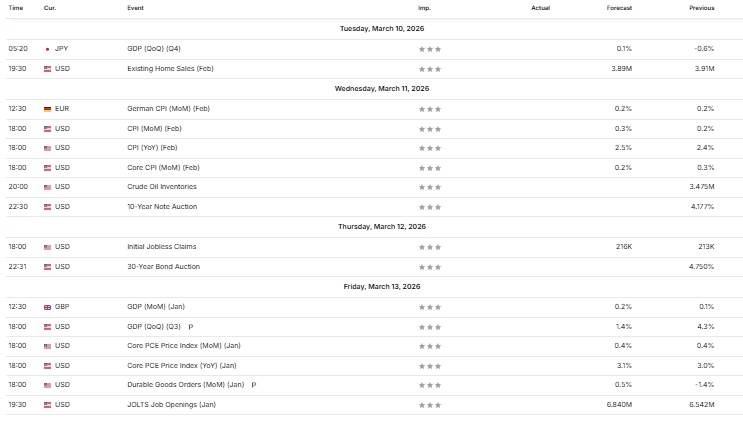
The forex market is expected to experience increased volatility this week as traders monitor major economic releases and rising geopolitical tensions. Key data including US CPI, Core PCE, and GDP reports will provide important insights into inflation trends and the future direction of Federal Reserve monetary policy.
At the same time, UK GDP and German inflation data could influence sentiment in the British pound and euro, while ongoing tensions in the Middle East may impact oil prices and global risk appetite. These developments are likely to shape movements across major currency pairs, commodities, and safe-haven assets.
In this weekly forex outlook, we break down the most important economic events, geopolitical developments, and trading opportunities that could influence the forex market in the days ahead.
US CPI Inflation Data Could Trigger Major USD Volatility
The US Consumer Price Index measures changes in consumer prices and is one of the Federal Reserve’s key inflation indicators. This release includes headline CPI, core CPI, and monthly inflation data. If inflation rises above forecasts, the Fed may keep interest rates higher for longer. Softer inflation may increase expectations of policy easing.
Impact:
Higher inflation strengthens the USD and pressures the EURUSD and GBPUSD. Lower inflation weakens the dollar, supporting risk currencies and commodities like gold.
Higher inflation strengthens the USD and pressures the EURUSD and GBPUSD. Lower inflation weakens the dollar, supporting risk currencies and commodities like gold.
US Core PCE Price Index: The Federal Reserve’s Favourite Inflation Gauge
The Core Personal Consumption Expenditures Price Index is the Federal Reserve’s preferred inflation measure because it excludes volatile food and energy prices. Markets closely monitor this release to assess underlying inflation trends. Higher-than-expected data suggest persistent inflation, while weaker numbers may signal slowing price pressures.
Impact:
Stronger PCE data boosts USD and increases rate hike expectations. Weaker inflation readings may weaken the USD and support risk assets and commodity currencies.
Stronger PCE data boosts USD and increases rate hike expectations. Weaker inflation readings may weaken the USD and support risk assets and commodity currencies.
US GDP Growth Data Signals Strength of the World’s Largest Economy
The Gross Democratic Product report measures overall economic growth in the United States. This release reflects consumer spending, business investment, and government activity. Strong GDP growth signals economic resilience, while weaker data could indicate slowing momentum and influence expectations for future Federal Reserve policy decisions.
Impact:
Stronger GDP supports USD and risk sentiment. Weak economic growth pressures the dollar and increases speculation about future policy easing.
Stronger GDP supports USD and risk sentiment. Weak economic growth pressures the dollar and increases speculation about future policy easing.
UK GDP Data Could Drive Volatility in GBP Pairs
UK GDP measures economic growth across Britain’s economy and is closely monitored by the Bank of England when evaluating interest rate policy. If the economy expands faster than expected, it suggests strong demand and potential inflation pressure. Weak growth may increase concerns about an economic slowdown.
Impact:
Stronger GDP supports GBP and lifts GBPUSD. Weak growth pressures the pound and increases expectations of accommodative Bank of England policy.
Stronger GDP supports GBP and lifts GBPUSD. Weak growth pressures the pound and increases expectations of accommodative Bank of England policy.
German CPI Inflation Data Could Influence the Euro
Germany’s Consumer Price Index reflects inflation trends in the Eurozone’s largest economy. Because Germany plays a dominant role in the region, this data often influences expectations around European Central Bank monetary policy. Rising inflation could increase pressure for tighter policy, while weaker data may signal easing price pressures.
Impact:
Higher German inflation strengthens the EUR and supports the EURUSD. Lower inflation weakens the euro and reduces expectations of tighter ECB policy.
Higher German inflation strengthens the EUR and supports the EURUSD. Lower inflation weakens the euro and reduces expectations of tighter ECB policy.
Iran War Escalation Drives Global Market Volatility
Escalating tensions involving Iran, Israel, and the United States have increased geopolitical uncertainty across global markets. Military strikes and retaliation risks are raising fears of a wider regional conflict. Traders closely monitor such developments because geopolitical instability often shifts capital toward safer currencies and assets.
Impact:
Rising geopolitical risk strengthens safe-haven currencies like USD, CHF, and JPY while increasing volatility across major forex pairs and global financial markets.
Rising geopolitical risk strengthens safe-haven currencies like USD, CHF, and JPY while increasing volatility across major forex pairs and global financial markets.
Strait of Hormuz Crisis Threatens Global Oil Supply
The Strait of Hormuz is one of the world’s most important oil shipping routes, carrying a large portion of global crude exports. Military tensions in the region have increased concerns about shipping disruptions. Any restrictions or attacks on tankers could reduce oil supply and quickly move energy markets.
Impact:
Oil supply disruptions typically push crude prices higher, strengthening oil-linked currencies like CAD and increasing global inflation expectations.
Oil supply disruptions typically push crude prices higher, strengthening oil-linked currencies like CAD and increasing global inflation expectations.
Oil Prices Surge Amid Middle East Conflict
Oil prices have been rising as traders price in potential supply disruptions from the Middle East conflict. The region accounts for a significant share of global oil production, and any prolonged instability can reduce supply availability. Higher energy prices can influence inflation trends worldwide.
Impact:
Higher oil prices increase inflation pressure globally, strengthen commodity currencies, and influence central bank policy expectations across major economies.
Higher oil prices increase inflation pressure globally, strengthen commodity currencies, and influence central bank policy expectations across major economies.
Global Markets Shift to Safe Haven Assets
As geopolitical tensions intensify, investors often reduce exposure to risk assets such as equities and emerging markets. Instead, capital flows toward safe-haven assets like US Treasuries, gold, and defensive currencies. This shift reflects growing uncertainty and risk aversion across financial markets.
Impact:
Risk aversion strengthens USD, CHF, and JPY while weakening risk sensitive currencies like AUD, NZD, and several emerging market currencies.
Risk aversion strengthens USD, CHF, and JPY while weakening risk sensitive currencies like AUD, NZD, and several emerging market currencies.
Forex Market View
USD (US Dollar)
The US dollar is expected to remain highly volatile this week as traders focus on key economic releases including US CPI, Core PCE, and GDP data. These indicators directly influence Federal Reserve policy expectations. Strong inflation or growth data could reinforce higher interest rate expectations and support USD demand. However, weaker inflation data may increase expectations of policy easing and pressure the dollar. Ongoing geopolitical tensions may also support USD through safe haven demand.
EUR (Euro)
The euro will likely react to both German CPI data and US inflation releases this week. Germany’s inflation report is closely watched because it influences expectations around European Central Bank policy decisions. If German inflation rises, the euro could gain support. However, stronger US inflation data may strengthen the dollar and push EURUSD lower.
GBP (British Pound)
GBP sentiment will largely depend on the upcoming UK GDP report and broader US dollar momentum. Strong economic growth could support the pound by reinforcing confidence in the UK economy. However, weaker GDP data combined with strong US inflation figures may pressure GBPUSD lower as traders favor USD strength.
JPY (Japanese Yen)
The Japanese yen may benefit from safe haven demand as geopolitical tensions continue to influence global markets. Investors often move toward the yen during periods of uncertainty. However, stronger US economic data and higher US yields could support USDJPY upside during the week.
CAD (Canadian Dollar)
The Canadian dollar may be influenced by movements in oil prices as geopolitical tensions raise concerns about potential supply disruptions. Rising oil prices typically support the Canadian economy. If oil prices continue to rise, CAD could strengthen. However, strong US economic data may support USD and push USDCAD higher.
AUD (Australian Dollar)
The Australian dollar is sensitive to global risk sentiment and may face pressure if geopolitical tensions increase market uncertainty. However, weaker US inflation data could reduce USD strength and allow AUDUSD to recover during the week.
NZD (New Zealand Dollar)
NZD movement will likely depend on global risk appetite and US dollar momentum. Rising geopolitical tensions could push investors toward safe-haven assets. If risk sentiment improves and US inflation weakens, NZDUSD may see short-term upside.
Gold, Oil & Crypto Outlook
Gold
Gold prices may remain volatile this week as traders react to geopolitical tensions and key US inflation data. Rising conflict risks often increase demand for safe haven assets like gold, while inflation indicators such as CPI and Core PCE may influence expectations around Federal Reserve policy. If geopolitical tensions escalate or inflation weakens the dollar, gold could see further upside. However, stronger US data and rising bond yields may limit gains.
Oil
Oil markets will likely stay sensitive to developments in the Middle East conflict, particularly concerns around supply disruptions in key shipping routes. Any escalation could reduce global oil supply and push energy prices higher. Rising oil prices may increase inflation pressures globally and support oil-linked currencies. However, easing tensions could stabilise supply expectations and limit further price increases.
Crypto
Cryptocurrency markets may react to shifts in global risk sentiment and macroeconomic data this week. Assets like Bitcoin often behave as high-risk investments and tend to move with broader market confidence. If geopolitical tensions increase risk aversion, crypto markets may face pressure. However, weaker US inflation data and improving investor sentiment could support short-term recovery in digital assets.
Trader’s Edge: Week Ahead Trading Tips
- Focus on USD-Driven Trades This Week: With major releases like US CPI, Core PCE, and GDP scheduled, the US dollar will likely drive overall market direction. Pairs like EURUSD, GBPUSD, and USDJPY may offer the clearest setups.
- Trade Around Inflation Data Carefully: US CPI and Core PCE can trigger sharp volatility because they influence Federal Reserve policy expectations. Strong inflation may strengthen USD, while weaker data could push the dollar lower.
- Watch Geopolitical Headlines for Sudden Moves: Rising tensions in the Middle East could shift global risk sentiment quickly. Safe haven assets like USD, JPY, and gold often gain during geopolitical uncertainty.
- Monitor Oil Prices for CAD Opportunities: If oil prices rise due to supply concerns, the Canadian dollar may strengthen. This could create potential trading opportunities in USDCAD.
- Be Cautious Around Major News Releases: High-impact events such as CPI, GDP, and major geopolitical headlines can cause sharp market swings. Waiting for the initial volatility to settle can help traders find clearer setups.
- Prioritise Risk Management in Volatile Markets: With multiple economic releases and global uncertainties this week, traders should focus on disciplined position sizing and avoid overexposure during major news events.
Stay Ahead This Week with MarketInvestopedia
Make smarter trading decisions with clear market analysis, weekly forecasts, and actionable insights.
Join thousands of traders who rely on MarketInvestopedia for timely updates on forex, gold, oil, and crypto markets.
Subscribe now for FREE and get market-moving insights delivered straight to your inbox, before the moves happen.
Disclaimer
This newsletter shares market insights and expectations for the week ahead. These are forecasts, not guarantees. Market conditions can change rapidly due to new data or unexpected events. Always trade responsibly and manage your risk.