


Stay ahead of the market moves.
Forex Market Outlook This Week
June 1 - June 5
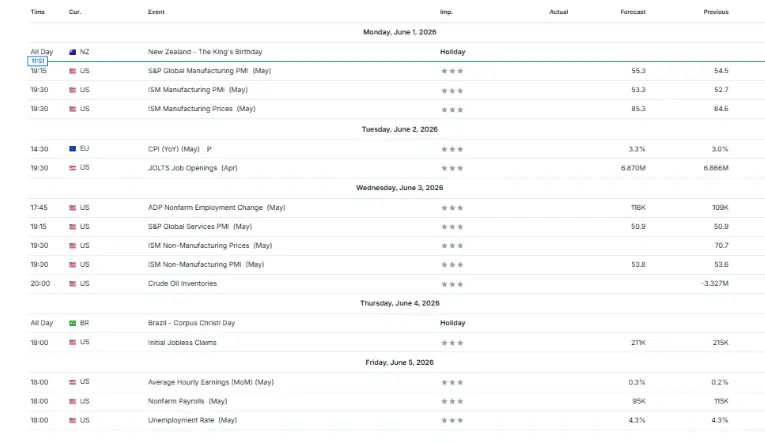
A new trading week brings several important economic reports that could move the forex, gold, and oil markets. Key updates on U.S. inflation, jobs, manufacturing, and services activity will give traders a better understanding of how the economy is performing. These reports can often lead to increased market volatility and create new trading opportunities.
In this week's newsletter, we'll cover the major events to watch, explain why they matter, highlight the currency and commodity pairs most likely to be affected, and share useful trading tips to help you prepare for the days ahead.
Can U.S. factory growth keep surprising markets and support the dollar's momentum?
The S&P Global Manufacturing PMI measures business activity in the U.S. manufacturing sector. It shows whether factories are producing more goods, receiving new orders, and hiring workers. A higher reading suggests stronger economic activity, while a lower reading may signal slowing growth.
Impact:
Stronger-than-expected data can support the U.S. dollar, while weaker numbers may increase selling pressure and boost other major currencies.
Stronger-than-expected data can support the U.S. dollar, while weaker numbers may increase selling pressure and boost other major currencies.
Will factory activity strengthen enough to reshape expectations for the U.S. economy?
The ISM Manufacturing PMI is a closely watched indicator of factory performance in the United States. It tracks production, employment, new orders, and supplier deliveries. Traders use this report to gauge economic health and understand whether business conditions are improving or weakening.
Impact:
A strong reading may strengthen the dollar, while weaker data can raise concerns about growth and weigh on the currency.
A strong reading may strengthen the dollar, while weaker data can raise concerns about growth and weigh on the currency.
Are rising factory costs setting the stage for another inflation concern?
The ISM Manufacturing Prices Index measures changes in the prices manufacturers pay for raw materials and supplies. Rising costs can increase inflation pressure across the economy, while lower costs may suggest inflation is easing and becoming more manageable.
Impact:
Higher prices can boost expectations of tighter monetary policy, supporting the dollar. Lower prices may have the opposite effect.
Higher prices can boost expectations of tighter monetary policy, supporting the dollar. Lower prices may have the opposite effect.
Will inflation data push the euro toward its next major move?
The Eurozone Consumer Price Index (CPI) measures how quickly prices are rising across countries using the euro. Inflation is a key factor for European Central Bank decisions. Higher inflation may encourage policymakers to keep interest rates elevated.
Impact:
Higher-than-expected inflation can strengthen the euro, while weaker inflation may increase pressure on the common currency.
Higher-than-expected inflation can strengthen the euro, while weaker inflation may increase pressure on the common currency.
What do job openings reveal about the true strength of the U.S. labor market?
The JOLTS Job Openings report shows how many positions employers are trying to fill across the United States. A high number of openings often signals strong labor demand, while fewer openings may indicate businesses are becoming more cautious.
Impact:
Strong job openings can support the dollar by showing economic resilience, while weaker figures may hurt market confidence.
Strong job openings can support the dollar by showing economic resilience, while weaker figures may hurt market confidence.
Could private hiring numbers foreshadow a major payroll surprise ahead?
The ADP Employment Change report tracks hiring in the private sector before the official government jobs report. Although not always identical to Nonfarm Payrolls, it often provides an early look at labor market trends and hiring activity.
Impact:
A strong ADP reading can boost dollar demand, while weak hiring numbers may create downside pressure on the currency.
A strong ADP reading can boost dollar demand, while weak hiring numbers may create downside pressure on the currency.
Is the services sector still powering U.S. economic growth this quarter?
The S&P Global Services PMI measures activity in service-based industries such as finance, healthcare, hospitality, and technology. Since services make up a large share of the U.S. economy, this report offers important clues about overall economic performance.
Impact:
Strong service-sector growth can support the dollar, while weaker activity may raise concerns about economic momentum.
Strong service-sector growth can support the dollar, while weaker activity may raise concerns about economic momentum.
Are service-sector costs climbing again and fueling fresh inflation worries?
The ISM Non-Manufacturing Prices Index tracks price changes in the services sector. Rising costs can signal ongoing inflation pressure, while falling costs may suggest inflation is cooling. Traders closely watch this report for policy clues.
Impact:
Higher service-sector prices may strengthen the dollar through rate expectations, while lower costs can reduce that support.
Higher service-sector prices may strengthen the dollar through rate expectations, while lower costs can reduce that support.
Can strong services activity reinforce confidence in the U.S. economy?
The ISM Non-Manufacturing PMI measures business conditions across the services sector. It covers new orders, employment, business activity, and supplier deliveries. Because services dominate the U.S. economy, this report is a major market-moving event.
Impact:
Better-than-expected data often supports the dollar, while disappointing numbers may trigger weakness in the currency.
Better-than-expected data often supports the dollar, while disappointing numbers may trigger weakness in the currency.
Will shifting oil inventories trigger volatility across energy and currency markets?
The Crude Oil Inventories report shows changes in U.S. oil stockpiles. Rising inventories can suggest lower demand or excess supply, while declining inventories may indicate stronger consumption. Oil prices often react quickly to these figures.
Impact:
Large inventory changes can move oil-linked currencies like the Canadian dollar and influence broader market sentiment.
Large inventory changes can move oil-linked currencies like the Canadian dollar and influence broader market sentiment.
Are unemployment claims signaling resilience or cracks in the labor market?
Initial Jobless Claims measure the number of people filing for unemployment benefits for the first time. It is one of the most timely indicators of labor market conditions and helps traders identify changes in employment trends.
Impact:
Fewer claims usually support the dollar, while rising claims can signal labor market weakness and pressure the currency.
Fewer claims usually support the dollar, while rising claims can signal labor market weakness and pressure the currency.
Will wage growth accelerate and complicate the inflation outlook further?
Average Hourly Earnings tracks changes in worker pay across the United States. Rising wages can increase consumer spending but may also contribute to inflation. The report is closely monitored for clues about future monetary policy decisions.
Impact:
Faster wage growth can strengthen the dollar through inflation expectations, while slower growth may weaken support.
Faster wage growth can strengthen the dollar through inflation expectations, while slower growth may weaken support.
The jobs report that could decide the dollar’s next major direction.
Nonfarm Payrolls measures the number of jobs added or lost in the U.S. economy, excluding farm workers. It is one of the most important economic reports each month and often causes significant market volatility immediately after release.
Impact:
Strong job growth generally boosts the dollar, while weaker payroll numbers can trigger sharp currency market reactions.
Strong job growth generally boosts the dollar, while weaker payroll numbers can trigger sharp currency market reactions.
Will unemployment remain steady or hint at changing economic conditions?
The Unemployment Rate shows the percentage of people actively seeking work but unable to find jobs. It provides a broad view of labor market health and helps investors understand whether economic conditions are improving or weakening.
Impact:
A lower unemployment rate often supports the dollar, while rising unemployment can weaken confidence in the U.S. economy.
A lower unemployment rate often supports the dollar, while rising unemployment can weaken confidence in the U.S. economy.
Key Forex & Commodity Pairs to Watch This Week
- EUR/USD: Eurozone inflation and major U.S. labor market data could drive significant volatility, making EUR/USD a key pair to monitor.
- GBP/USD: Strong U.S. economic releases may influence dollar strength, creating trading opportunities and potential price swings in GBP/USD.
- USD/JPY: U.S. employment, inflation, and manufacturing reports could impact Treasury yields, making USD/JPY especially sensitive this week.
- AUD/USD: As a risk-sensitive currency pair, AUD/USD may react sharply to U.S. economic data and shifts in market sentiment.
- NZD/USD: Key U.S. releases and changing risk appetite could influence the New Zealand dollar's direction against the U.S. dollar.
- USD/CAD: Crude oil inventory data and major U.S. economic reports may drive volatility in this closely watched commodity-linked pair.
- USD/CHF: Safe-haven demand and high-impact U.S. data releases could create notable movement in USD/CHF throughout the week.
- XAU/USD (Gold): Gold traders will closely watch inflation, employment, and wage data as they shape expectations for future interest rates.
- WTI Crude Oil: Oil prices may react strongly to inventory figures, economic growth signals, and changing expectations for global energy demand.
Trader’s Edge: Week Ahead Trading Tips
- Focus on major U.S. economic reports, as they are likely to create the biggest market movements this week.
- Avoid entering trades just before high-impact news releases, as sudden price swings can increase trading risks.
- Keep a close watch on Nonfarm Payrolls, which often drives strong moves across forex and gold markets.
- Use proper risk management by setting stop-loss orders and avoiding oversized positions during volatile events.
- Monitor gold and oil alongside currency pairs, as commodity prices can influence broader market sentiment.
- Stay patient and wait for confirmation after major news releases before entering trades based on market reactions.
Common Mistakes to Avoid
Many traders make the mistake of chasing fast-moving prices, ignoring stop-loss orders, or risking too much on a single trade. Trading based on emotions instead of a clear plan can also lead to losses. Staying disciplined, managing risk, and avoiding overtrading can help traders make better decisions.
Stay Ahead of the Markets with MarketInvestopedia
Make confident trading decisions with clear, data-driven market analysis, weekly forecasts, and actionable insights designed for real traders. Join a growing community of traders who rely on MarketInvestopedia for timely updates across forex, gold, oil, and crypto markets.
Subscribe now for FREE and receive market-moving insights directly in your inbox, before the market reacts.
Disclaimer
This newsletter provides market insights and forward-looking expectations based on current data and analysis. These views are not financial advice or guarantees of future performance. Market conditions can change rapidly due to economic releases, geopolitical events, or unexpected developments. Always trade responsibly and use proper risk management.