Forex Market Structure
Other Post
Forex Market Structure
You know, even governments and central banks participate in the forex market. They not only participate but also move the entire foreign exchange. Thus, knowledge of the forex hierarchy, market structure, and how the forex market works is a must for a trader.
In this article, you will learn about the Forex Market Structure, its hierarchy, participants, and the role of these participants. So, let’s get started with the understanding of the forex market hierarchy.
Introduction to the Forex Market
The Forex Market is commonly known as the FX Market or the Foreign Exchange market. It is a place where a large number of traders are involved in the buying and selling of currency pairs. This entire process also reflects the forex market model, including market maker roles and liquidity providers that shape price movements through structural trading foundations.
There are more than 170 currencies traded in the forex market. Trillions of Dollars are traded in the forex market to take advantage of the change in the value of currencies. It is an over-the-counter (OTC) market where trading takes place between two parties and showcases a decentralized market structure.
In the forex market, individuals, companies, and central banks engage in the conversion of currencies.
Let us understand the Foreign exchange market example. Suppose you are traveling to the USA from India. To survive in the USA, you have to convert your Rupees to Dollars, and that’s how foreign exchange occurs. This simple example fits into the overall forex hierarchy, where retail participants sit at the bottom of the market structure.
A quick glance
In FX Market, many traders are involved in the buying and selling of currency pairs. Learn with example.
It is dynamic, complex, and ever-changing, with levels of liquidity and participation. Please have a look at its overview.
Based on participation, regulations, level of liquidity, and motivation, the Hierarchy of the Forex Market showed in the form of a pyramid.
Major Banks are placed at the top level, while retail traders are placed at the bottom. Learn about all the participants of the forex market and their roles.
Mastering Market Structure
The structure of the Forex Market is dynamic, complex, and ever-changing, with levels of liquidity and participation. Its structure is slightly different from other financial markets, such as stocks, indices, and crypto, making it a core topic in market structure trading, trading market structure, and understanding 4 market structures that influence price behavior.
There is no central exchange in the FX Market. The major participants in the forex market are brokers, dealers, traders, banks, and commercial companies. These layers form what is known as the forex hierarchy and define the forex model followed in global exchanges.
To make you understand the structure of the forex market efficiently, here are two diagrams that show the comparison between the structure of the Forex vs. stock market.
Structure of the Stock Market
The above diagram shows you the structure of the stock market. There is a buyer and a seller. In the middle of them, there are centralized exchanges such as NSE, BSE, and NYSE.
The Stock Exchange is a centralized market, which makes it less complex as compared to the forex market structure. It is very monopolistic as there is one entity that controls the prices and acts as a market maker within its own equity market structure.
The prices in the stock market can be easily altered and managed as it is well-managed by a central entity. In the stock market, a specialist can manipulate the quotes to get the desired results.
Forex Market Hierarchy

This forex hierarchy is one of the key components of structure trading and is very different from the 4 market structures taught in basic economics.
Forex Market Structure Analysis:
The above diagram shows the structure, which raises the question of how to read the Forex Market Structure. There is a huge difference between the structure of the Forex market and the stock market.
The FX market is a decentralized market. Daily, trillions of Dollars are traded on different forex brokerage platforms, as there is not even a single physical location where the traders go to buy or trade currencies.
On the basis of participation, regulations, level of liquidity, and motivation, the Hierarchy of the Forex Market is shown in the form of a pyramid in the above diagram. This forex hierarchy guides how liquidity providers, market makers, and price-setting institutions operate.
In the forex market, each participant looks for counterparties. Major Banks are placed at the top level, while retail traders are placed at the bottom on the basis of different factors. Let us understand all the participants of the Forex Market levels separately to understand its complex structure.
Participants of the Forex Market
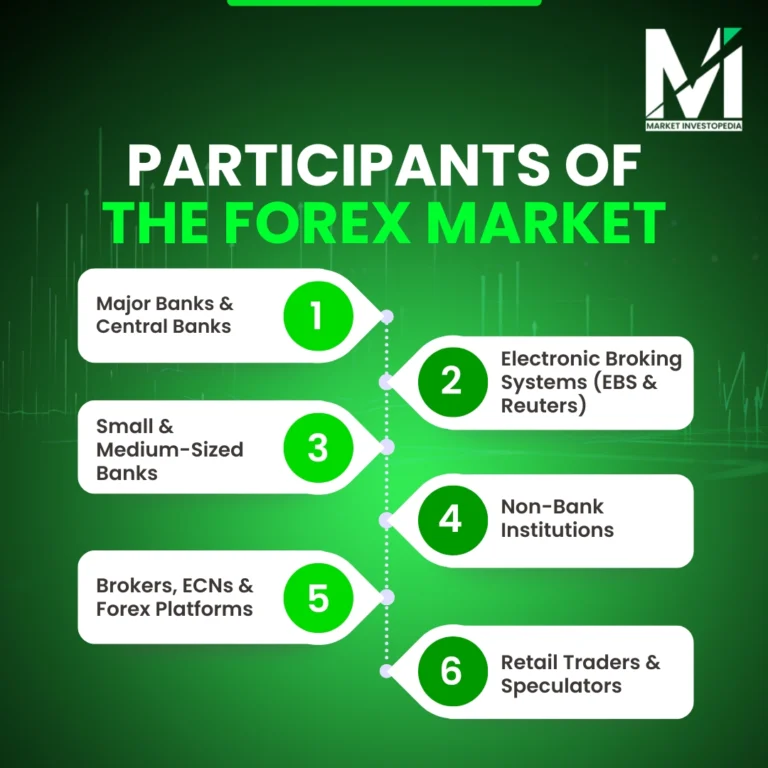
1. Major Banks
- Large Commercial Banks
- Central Banks
- Government Regulators
2. Electronic Brokerage Services
- The Reuters Dealing 3000-Spot Matching
- Electronic Brokering Services (EBS)
3. Small and Medium-Sized Banks
4. Retail ECNs and other institutions
- Hedgers
- Multinational Corporations (MNCs)
- Forex Brokers Platforms
5. Retail Traders
- Forex Brokers Platforms
- Retail Market Participants
- Speculators
Major Banks:
Major Banks are placed at the top of all participants of the Forex Market Structure. Based on the supply and demand of currency, these Banks determine the exchange rate of the currency pair. Major Banks include the Central Banks of the countries and some big commercial Banks. These banks also act as the prime liquidity provider forex institutions.
Commercial Banks:
Large commercial banks, also known as Super Banks, are among the most significant participants in complex Forex Market Structure patterns. As per the information, over 80% of all money traded in the market comes from these large commercial banks. These banks also contribute heavily to market maker activities and help maintain the forex market model.
Here are some major commercial players in the market:
- HSBC
- Bank of America
- Deutsche Bank
- UBS
- Morgan Stanley
- Citi Group
- RBS
- Goldman Sachs
Central Banks:
The major banks also include the central banks of countries. Each country has its own central Bank. The country reserves the right to print its currency and distribute it to other banks through its central Bank.
Central Banks control the market and make an effective market structure trading strategy. These central banks supply currencies to commercial banks to be exchanged in the foreign exchange market. For example, The US Federal Reserve, The European Bank, The Bank of England, The Bank of Japan, The Swiss National Bank, etc.
Government and Regulators:
Similar to individual traders, the governments of respective countries also participate in the forex market to hedge risk against inflation in order to boost their economies.
Besides the government, there are regulators of the government that regulate the activities and participants of the Forex Market.
The major regulators of the FX Market are the Financial Conduct Authority (FCA), the Prudential Regulation Authority (PRA), the Financial Services Compensation Fund (FSCS), etc.
2. Electronic Broking Services:
It is an electronic trading platform used by market-making banks to trade in foreign exchange on a daily basis. The Reuters Dealing 3000-Spot Matching and Electronic Brokering Services (EBS) are major Electronic Broking Services.
3. Small and Medium-Sized Banks:
There are various small and medium-sized banks that participate in forex trading. The banks provide their clients with services to change one currency into another. These banks make a profit through arbitrage and speculation, often exposed to liquidity sentence determinants in the trading environment.
4. Retail ECNs and Other Institutions:
There are various non-bank market traders, which include mutual funds, hedge funds, pensions, and other corporations. These institutions or organizations are the major players in the forex market. They engage in constant buying and selling of currencies. References were taken from Forex Market Structure books to present the role of each participant effectively.
Hedgers:
The term hedger is used for any individual or firm that buys or sells a commodity. These companies hedge the risk of price changes in commodities or assets they need to buy to run the business.
Multinational Corporations (MNC):
There are companies that have branches globally or in many other countries. These companies are the major participants of the Forex Market as they have to convert the currencies they earn from different countries into their own currencies; for this purpose, they participate in Forex.
Forex Brokers Platforms:
These broker platforms are major participants in the Forex Market structure. These are licensed corporations that help traders buy and sell currencies and help maintain market structure charts and pricing flows.
5. Retail Traders:
Retail traders are the bottommost players in the forex market structure. These participants include all people who are engaged in Forex Trading for genuine reasons and not just to make a profit.
Speculators:
A speculator refers to a person who participates in the FX market to make a profit based on their predictions after studying different factors. They identify patterns like Consolidation, bullish structures, and liquidity zones to make informed decisions.
How Forex Hierarchy Helps Traders
Helps You Select the Right Currency Pair
Understanding the Forex Hierarchy allows traders to know which currencies are influenced by major banks, liquidity providers, and central bank flows. So traders can select the right pair accordingly.
Gives You Early Insights into Smart Money Moves
When you know how the forex hierarchy works from top to bottom, you can track how big institutions trade. Tracking the activities of central banks, major banks, and hedge funds helps in planning your own trades.
Provides Faster Market Updates and Reactions
Top-level participants react first to global news. By understanding this structural flow, traders can predict short-term volatility and position themselves before retail traders react.
Tracking Liquidity & Timing Trades
Knowing where liquidity sits in the market structure helps traders identify the right time for trades. This reduces spreads, slippage, and unnecessary losses.
Makes You Identify Advanced Setups
Once you understand the forex model and hierarchy, you stop trading like retailers at the bottom. You begin analyzing liquidity, institutional footprints, and macro flows, leading to higher accuracy and finding an edge market approach.
Bottom Line
The structure of the Forex Market is very complex. With a large number of participants and no single physical trading location, understanding the forex hierarchy, market makers, liquidity providers, and structural trading concepts becomes essential.
A trader is one amongst thousands of small boats floating in the massive ocean of the forex market. Therefore, a trader must understand the Forex market structure, its participants, and how forex market works to compete with experienced players.
This knowledge also helps traders identify bullish structures, market structure changes, and apply correct structure trading approaches.
Still find the forex market hierarchy complex? Attend Market Investopedia’s insightful sessions and clear all your doubts at once.
Share The Post with others
Category :
Share :