
Ramadan Trading Strategy 2026: Stock, Forex, and Crypto Market Behaviour Explained
Other Post

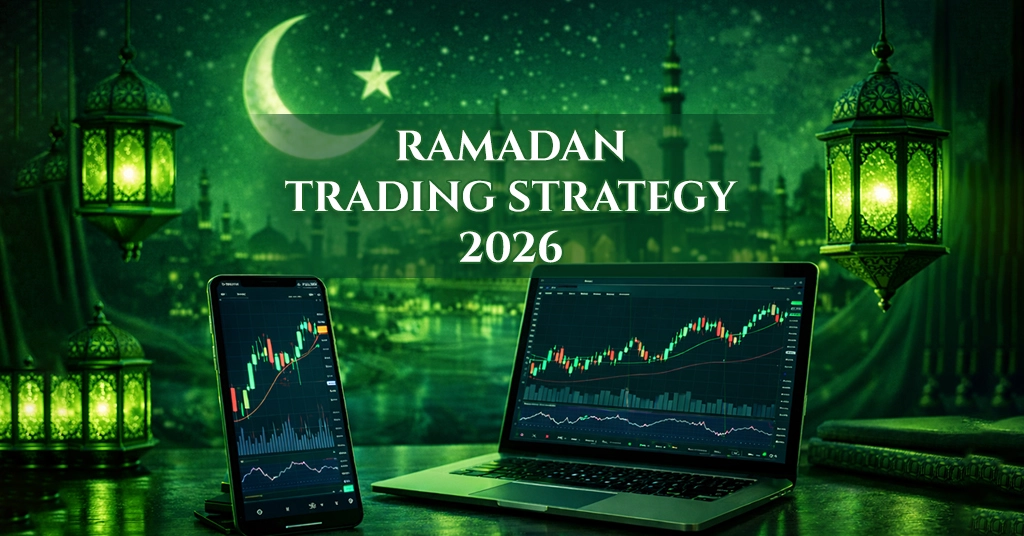
The year 2026 is drawing near Ramadan, and changes in the trading conditions are always evident among traders in the markets of world economies in the near future. Changes in daily activities, the level of energy, and involvement in the market can determine the behaviour of the stock market, the forex market, and the crypto market.
Instead of making assumptions that the markets will either perform well or badly, seasoned traders are thinking about how the liquidity, volatility, and the trading hours might be affected during Ramadan. Ramadan trading strategy is not short cut, a trick of seasons. It is concerning the learning of the behaviour of the market, the ability to make disciplined and risk-aware trading decisions.
What Is a Ramadan Trading Strategy
A Ramadan trading strategy implies adapting your trading behaviour in Ramadan rather than imposing the same trading behaviour into a new routine and market condition.
In this month, traders can have sleeping cycles, concentration, and screen time fluctuations. Due to this, a pragmatic approach gives more emphasis on planning, awareness, and risk management,t and not on frequent buying, selling, and trading.
Simply put, the Ramadan trading strategy concentrates on:
- Awareness of the variation in the routine and in concentration.
- Planning and analysing before rushing to do something.
- Using more power in risk management.
- Monitoring market behaviour as opposed to overtrading.
The strategy is applicable in every big market:
- Stock trading
- Forex trading
- Crypto trading
A quick glance
Zakaah money is normally donated immediately to individuals who require it and not invested. The ability to provide it is dependent on the scholars, the urgency of the need, and regulations to ensure that recipients are not deprived of their rights.
Ramadan has the potential to alter the manner in which numerous individuals trade, the ease with which individuals trade, or the extent to which prices vary over the short run. And it does not offer better or worse profits. The outcomes are based on the nature of the asset, the nation,n and the behaviour of traders.
Ramadan does not render trading more or less profitable. Your plan, discipline, risk management, and market make a profit. Some traders take this period to study and get ready rather than trade aggressively.
Forex trading will not come to an end in 2026. Trade, finance, and protection of risk are important through currency markets. It may be a long time before rules, technology, and the number of traders change.
Trading is permitted or not in Islam, based on the instruments, the motive, and the risk, and it should be in accordance with the Shariah. Experts should advise Muslims on how to ensure that their trading is done safely and according to their beliefs.
The best time during Ramadan to trade does not exist. The majority of traders select the hours when trading is the most comfortable, and they are the most attentive, and they rearrange their strategies based on their energy and the market busyness all over the globe.
Simple example
When a trader tends to be actively trading in high energy hours, Ramadan will likely demand fewer but more discriminating trades. The trader does not have to stick to the same speed and devote more attention to the analysis and after-trade analysis than to the execution.
This is the reason why Ramadan trading strategies do not focus on the amount traded, but rather the quality of the decision made and adherence to it.
Ramadan Effect on Stock, Forex, and Crypto Markets
The Ramadan effect on financial markets is mainly driven by changes in trader participation rather than the calendar itself. Adjusted working hours, reduced activity during certain sessions, and shifts in global participation can influence market behaviour.
Different markets respond differently during Ramadan.
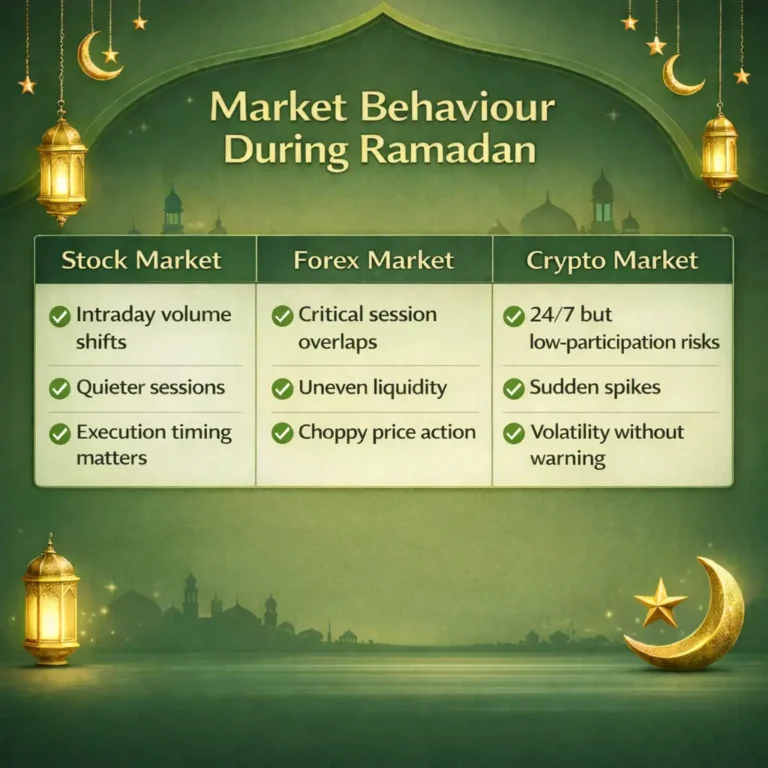
Key points to understand:
- These are observations, not guarantees
- Behaviour varies by region and asset.
- The Ramadan effect reflects human behaviour, not market rules
For example, stock traders may notice quieter intraday periods, while forex traders may experience choppy movement during session transitions. Crypto markets, despite being open continuously, can show sudden moves during periods of low participation.
Because of these differences, experienced traders avoid assumptions and focus on market context rather than seasonal expectations.
Ramadan Trading Patterns and Market Volatility
Many traders search for Ramadan trading patterns, expecting predictable price movements. This is where most misunderstandings occur.
While certain behavioural trends may appear during Ramadan, they are not consistent enough to be treated as reliable trading signals.
What traders often assume
- Volatility will always remain low.
- Price movements will repeat each year.
- Markets will behave the same across assets
The reality
- Some days are quiet, others are unexpectedly volatile
- Volatility can appear suddenly due to reduced liquidity.
- Behaviour differs across stocks, forex, and crypto
For example, a crypto trader may see sharp price movements during low-volume hours, while a forex trader may face choppy action during session changes.
Market volatility during Ramadan is often less predictable than simply higher or lower. Understanding how volatility behaves is more important than trying to chase it.
Ramadan Market Liquidity and Why It Matters
Liquidity becomes especially important when trading during Ramadan. As participation shifts, liquidity can become uneven, directly affecting trade execution.
When liquidity changes, traders may experience:
- Slippage on entries or exits
- Wider spreads
- Inconsistent execution
Market Type | Liquidity Behaviour During Ramadan | Main Risk |
Stocks | Lower liquidity during certain sessions | Slippage |
Forex | Liquidity depends on active sessions | Choppy execution |
Crypto | Liquidity shifts rapidly | Sudden price spikes |
Because execution risk increases, many traders avoid aggressive strategies during Ramadan. Instead, they focus on understanding liquidity, adjusting position sizes, and improving execution discipline.
Market Investopedia offers courses that explain liquidity behaviour, execution quality, and risk management across stocks, forex, and crypto. These courses help traders avoid common execution mistakes, especially during periods of uneven market participation.
Pre-Market Analysis and Simple Ramadan Trading Rules
It is better to pre-analyse the market rather than respond to trades during Ramadan. Planning also assists traders to prevent cases of making emotional decisions and to remain unchanged even when they are exhausted.
Pre-market analysis usually contains:
- Surveying increased periods.
- Indicating the major support and resistance levels.
- Strategising situations rather than mere forecasts.
Numerous traders go by simple rules during Ramadan to maintain focus and safeguard money:
- Limit the number of trades
- Reduce risk on each trade
- Don’t trade at times when concentration is low.
- Do not make emotional choices when one is not energetic.
Such rules are not religious rules. They are feasible boundaries that are aimed at regulating danger and maintaining order. They apply to stocks, forex, and crypto.
Is Trading Haram During Ramadan
A lot of traders seek to determine whether it is prohibited to trade during Ramadan or not. This is a subjective question and requires personal beliefs, morals, and local religious counselling.
Educationally, not all people are necessarily permitted or not permitted to trade. It is based on the purpose, procedure, and extent of speculation. Other traders desire ethical conduct, no high-risk, gambling-like conduct, or emotional decisions.
Learning Before Trading: Demo Accounts and Skill Building
Ramadan slows down the trading process, and thus it is a good period to learn and not necessarily to trade.
Most traders take this time to play free demo accounts to test strategies, as well as get to know how the market behaves and enhance discipline without putting money at stake. Demo trading allows traders to view buying, selling, and trading options in the actual market without any pressure.
Rather, during Ramadan, a lot of Muslim traders trade less, adopt tougher risk provisions, or learn more than they trade. This is equal to such values as discipline, patience, and responsibility.
It is not a religious law, but an informative discussion. The traders are advised to seek reliable local advice and make up their minds on the belief and values.
Traders do not have to impose live trades; they can concentrate on:
- Studying market structure
- Improving risk management
- Reviewing past trades
- Dynamics of multi-asset behaviour.
Market Investopedia also provides courses that facilitate an approach to learning. These courses focus on long-term competencies in stocks, forex, and crypto as opposed to short-term noise.
Why Ramadan Is a Good Time to Learn Trading Skills
Active trading activities are usually hampered by Ramadan since day-to-day activities and concentration are hampered. Having less impulsive decisions and an opportunity to react to all actions, traders have time to stop, analyse, and have a clear look at how they do things.
The given time promotes abandoning short-term outcomes and touching the realities of the market at a more profound level. The traders are not as much tempted to hurry in buying and selling goods they want, and tend to inquire why things occur.
During the period of Ramadan,n traders tend to enjoy:
- Increased intellectual discipline and forbearance.
- More honest in decision reviews.
- More emphasis on core values rather than results.
This shift in mentality can make traders realise their habits, identify the weak points, and be able to plan their stable performance after Ramadan. Market Investopedia backs it up with market behaviour, risk awareness, and structured thinking courses available in stocks, forex, and crypto. This assists the traders in acquiring skills that are not limited to a specific trading period.
Conclusion
Ramadan trading is not about evading markets and seeking shortcuts. It is about thinking, discipline, and learning.
Ramadan 2026 will provide traders with the opportunity to monitor the behaviour, liquidity,y and volatility of the stocks, forex, and crypto. Prepared and learned traders will normally revisit with better thoughts and resolute decision-making abilities.
Structured learning can help those who are interested in long-term consistency and not shortcuts. Market Investopedia professional courses are designed so as to enable the trader to develop skills that do not become useless once Ramadan is over and the economic climate changes.
Category :
Share :